
Operational Data Management - Supporting ship-borne science
As the focal point for environmental science data stewardship in the UK, the NERC Environmental Data Service (EDS) combines innovative project work with vital core-service provision, delivering world-leading data management support and expert advice to UK researchers. One of these key services is assisting ship-borne science. EDS data managers maximise the scientific value of every research voyage, through supporting every stage of ship-borne science; from cruise planning and data collection, to archiving, visualisation, and publishing.
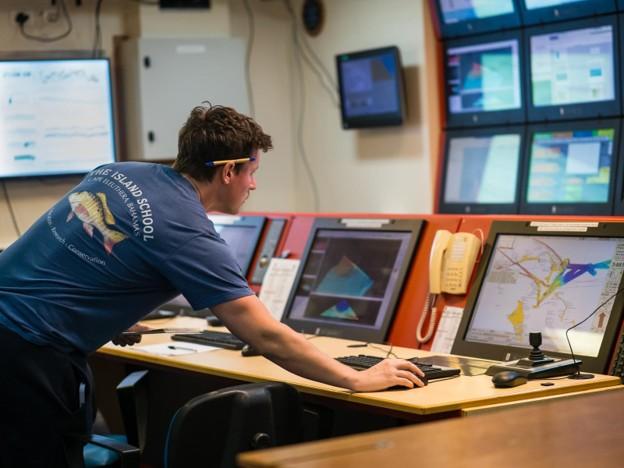
Image above: BODC data manager, Jordan Atherton on board NERC research ship RRS Discovery
Floating laboratories
Oceans cover 70% of Earth's surface and play a vital role in the global environment. They also support human society through providing resources, transport, and recreation. So it's no surprise that one of our five data centres is entirely dedicated to marine science – the British Oceanographic Data Centre (BODC), and all others are involved in data related to the marine environment in some form. The National Geoscience Data Centre (NGDC) manages seabed and sub-seabed marine geoscience survey data; geophysical data and seabed sample data from grabs and cores. The UK Polar Data Centre (UK PDC) manages decades of cruise data from around the Southern Ocean; from bathymetry data to biogeochemical cycling, from benthic imagery to krill surveys. The Centre for Environmental Data Analysis (CEDA) manages marine atmosphere and sea-surface temperature data (usually from satellites), along with aerosol observations. The Environmental Information Data Centre (EIDC) holds seabird data about breeding success, survival rates and diet. Ocean behaviour is also a key part of climate change projections – which are held by several data centres.
NERC owns three research vessels; the RRS James Cook and RRS Discovery, both operated by the National Oceanography Centre (NOC), and the RRS Sir David Attenborough, operated by the British Antarctic Survey (BAS). Equipped with a suite of scientific facilities and instruments, these platforms greatly enhance our capacity for understanding the oceans and their role in the global system. These vessels act as floating laboratories. Researchers use them to collect data, carry out experiments at sea and send data back to shore in near real time. During research cruises, scientists from many disciplines work side by side. This creates opportunities to tackle complex scientific questions together.
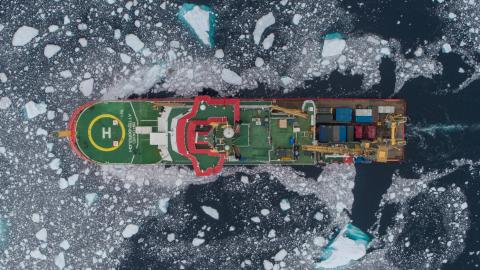
Image: RRS Sir David Attenborough in ice from above (Photo credit: Pete Bucktrout)
Planning and guidance
In the year (or more!) preceding a cruise, NERC EDS data managers attend cruise planning meetings to understand the research being undertaken, instruments, sensors, and data streams involved, and data outputs generated. In some cases, they work with scientists to develop and refine data management plans (DMPs) helping teams allocate resources and understand responsibilities. DMPs also include information such as the data processing procedures required. Data managers also help design and develop data acquisition systems, which may include the automated recording of metadata, graphical displays, visualisations and dashboards, and even initial processing and quality checks.
BODC and UK PDC have previously presented at the NERC Chief Scientist Training Workshop where every NERC-funded Chief Scientist leading a research cruise is invited to attended to find out everything they need to know to run a successful research cruise.
Support at sea
Then comes the cruise itself, with EDS data managers being deployed for weeks on board. While underway, data managers support the scientists in best-practice data acquisition, gathering quality metadata to ensure long-term accessibility and reuse value of the data when archived. Cruise datasets cover a range of instrumentation and data types, such as bathymetric mapping of the seafloor using on-board echosounders, Conductivity-Temperature-Depth (CTD) profiling and sampling of the water column, deployment of underwater submersibles for image and video analysis of marine benthos, and collection of physical samples; from sediment cores to specimens recovered from nets and trawls. Data managers also assist the cruise chief scientist in preparing a cruise summary report for the Cruise Inventory and a full cruise report, which includes a dedicated section on data management with a detailed description of all datasets being generated during the cruise.
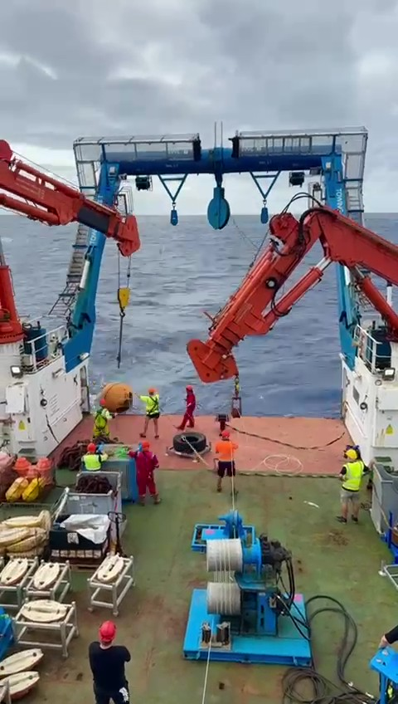
Image: deployment of a RAPID mooring on board RRS Discovery.
Preserving value
On return to shore, data, along with the physical specimens and samples, are transferred back to the UK for processing, publishing, and permanent storage in line with the FAIR principles for open access. All cruise data are held indefinitely at NERC EDS data centres. After quality checks, data are published in catalogues and assigned a digital object identifier (DOI). At BODC, data is entered into the National Oceanographic Database (NODB). At the UK PDC, it’s entered into the Discovery Metadata System (DMS). By assigning persistent identifiers, applying quality controls, and creating standardised metadata records, EDS data centres ensure that cruise data remain discoverable and reusable long after the voyage has ended.
Maximising return on investment
Research vessels are a major national investment. Through careful planning and design, ensuring that data collected during cruises are properly documented, preserved, and openly available for reuse, the NERC EDS extends the value of every voyage beyond its original scientific objectives. This supports future research, encourages collaboration across disciplines and helps the public get the greatest value from investment in environmental science.
If you are looking for guidance with data management for your next NERC funded cruise, please contact your assigned NERC data centre or email data@nerc.ukri.org.
Note: AI was used as a support tool in developing this article alongside input and review from subject matter experts.