
Project summary
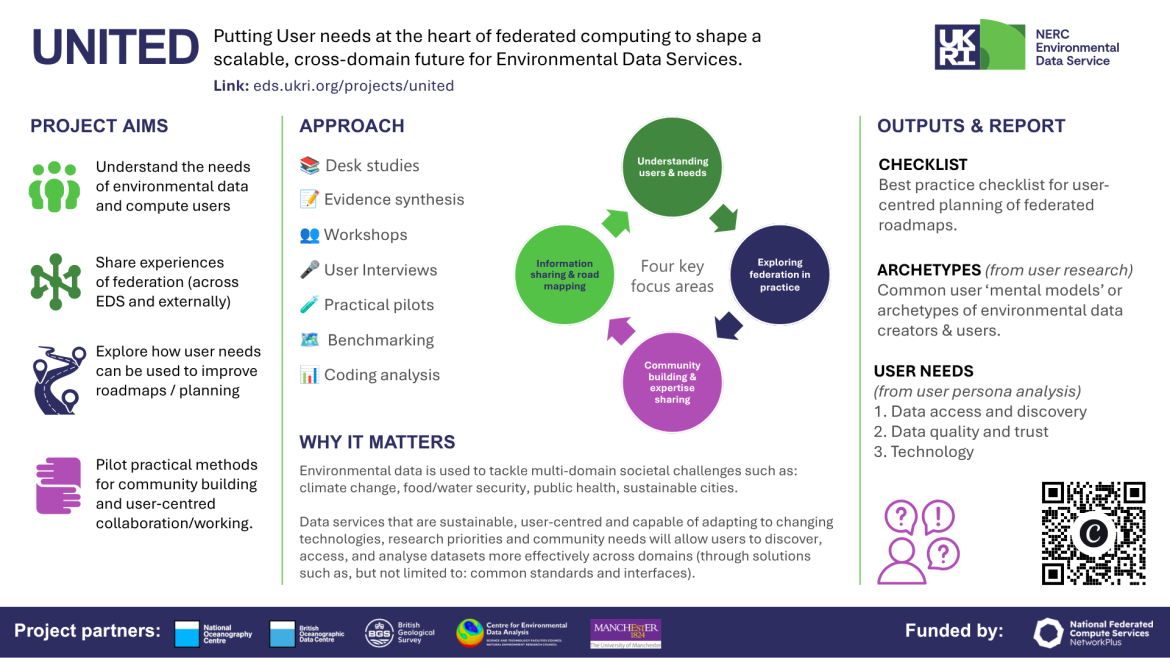
Aims -
- To capture and reflect on our existing experience of federation within the Environmental Data Service, including benefits, challenges, and lessons learned
- To understand who uses environmental data and compute, and what they need to work effectively across federated services
- To explore how user needs can be embedded into federated roadmaps and governance
- To identify and pilot practical mechanisms for internal community building, information sharing, and user‑centred working across federated services
Why it matters
Environmental data is used to tackle multi-domain societal challenges such as: climate change, food/water security, public health, sustainable cities. Data services that are sustainable, user-centred and capable of adapting to changing technologies, research priorities and community needs will allow users to discover, access, and analyse datasets more effectively across domains (through solutions such as, but not limited to: common standards and interfaces).
Funding - 168K project. We acknowledge the support of the National Federated Compute Services NetworkPlus who have funded this work through the Engineering and Physical Sciences Research Council (EPSRC) under Grant No. EP/Z534493/1
Timeline - 1st August 2025 to 31st July 2026
Core project team - Monica Hanley, Poppy Townsend, Jennifer Bulpett, Ola Podgorska, Louise Darroch, Matthew McCormack, Carl Watson, Maura Halstead, Paulius Tvaranavicius
Previous research - The project builds on the outcomes of the BOOST-EDS project - specifically the work on 'User centred approaches for environmental data services: embedding co-creation and collaboration'. It also leverages work from the AMPLIFY-EDS project and the NERC Digital Solutions Programme.
About the project
Federated data and compute services have an increasingly important role in supporting interdisciplinary environmental research. In practice, users often experience these services as fragmented, difficult to navigate and disconnected from their needs. The UNITED project explored how user-centred approaches can strengthen federated services, using the Environmental Data Service (EDS) as a case study. The project examined the practical realities of federation, identified lessons from existing federated organisations, and developed recommendations to help future federated services deliver greater value to their communities.
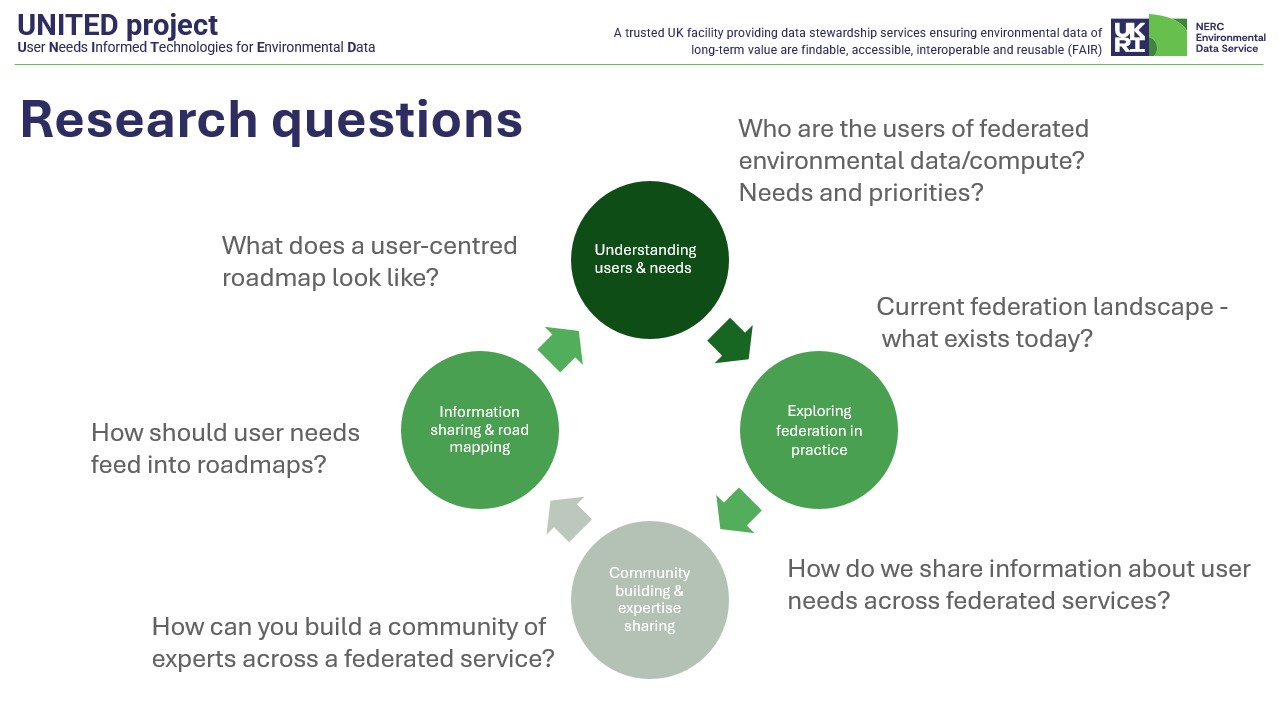
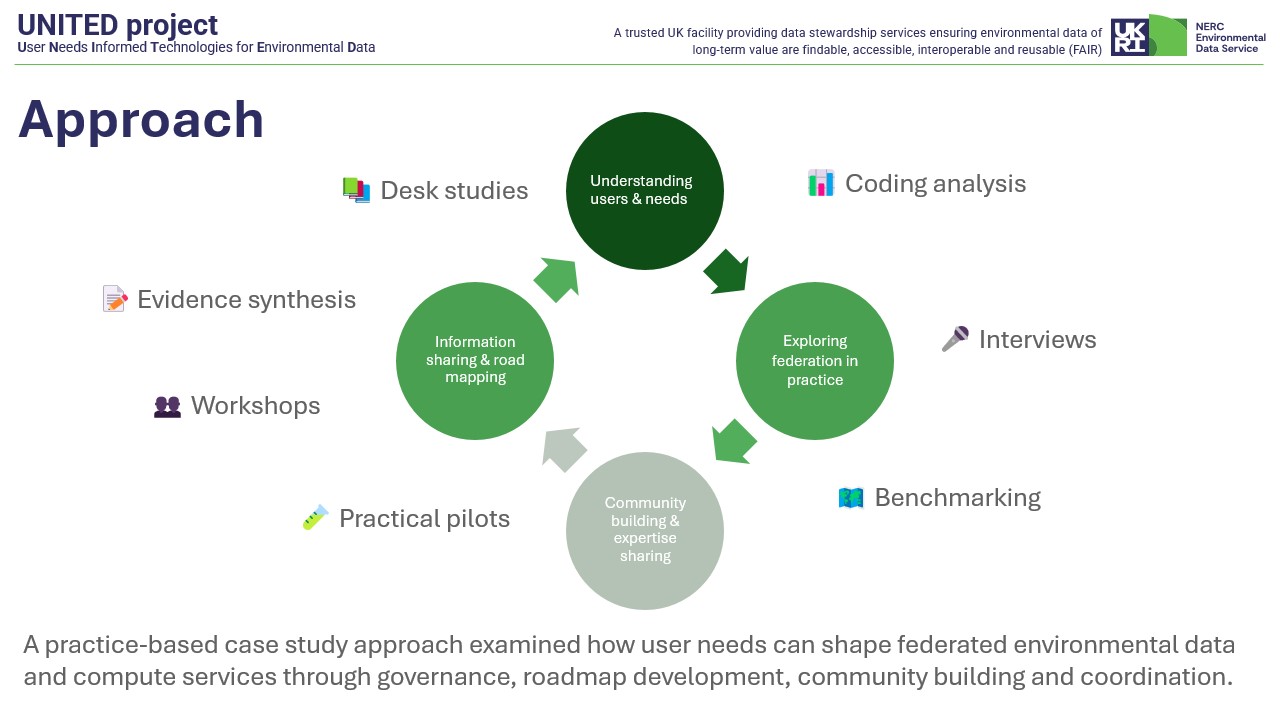
The work combined user research, stakeholder interviews, desk studies, roadmap reviews and practical pilots focused on community building, governance, ways of working and information sharing.
Across these activities, a consistent finding emerged: successful federation depends as much on people, culture and governance as it does on technology. A federation must provide a clear value proposition that is greater than the sum of its individual parts, supported by a shared vision, common tools, sustainable funding and effective coordination.
Four key themes were identified:
- Federations need a clearly defined purpose, supported by a shared technical foundation and common tools that enable collaboration and interoperability.
- Long-term success requires dedicated governance structures, sustainable funding models and active management of organisational risks.
- Federated organisations should invest in their culture and ways of working, creating conditions that encourage collaboration, transparency, experimentation and continuous improvement.
- User needs should be considered throughout the lifecycle of the federation. This can be achieved in different ways, including through ongoing feedback and service design, with the goal to challenge assumptions and reveal opportunities for improvement on an ongoing basis.
The project recommends 13 actions across these themes, including establishing a strategic vision before funding decisions are made, mandating shared tools and standards, creating dedicated coordination functions, diversifying funding streams, strengthening risk management, improving interoperability between organisations, embedding agile ways of working, implementing continuous feedback loops, and using service design methods to better understand users and the value delivered by the federation. Together, these recommendations provide a practical framework for developing federated services that are sustainable, user-centred and capable of adapting to changing technologies, research priorities and community needs. While developed within the environmental data domain, the findings are relevant to any organisation seeking to build or strengthen federated digital infrastructure and services.
Project reports/outputs
Main overview report
Townsend, P., Hanley, M., Podgorska, A. (Ola) H., Halstead, M., Watson, C., McCormack, M., Darroch, L.& Bulpett, J. (2026). Towards user-centred federated data services: insights from the environmental domain. Zenodo. https://doi.org/10.5281/zenodo.21642608
Sub-reports
Halstead, M., Watson, C., Tvaranavicius, P., Kingston, R.& Heysham, N. (2026). User persona data used for exploring existing environmental user research via a coding analysis [Data set]. Zenodo. https://doi.org/10.5281/zenodo.21640305
Halstead, M. (2026). Coding analysis for exploring existing environmental data user research [Data set]. Zenodo. https://doi.org/10.5281/zenodo.21640746
Townsend, P.& Watson, C. (2026). The NERC Environmental Data Service - historical context and ongoing transformation into a federated service. Zenodo. https://doi.org/10.5281/zenodo.21641360
Halstead, M.& Townsend, P. (2026). Exploring existing environmental data user research: a coding analysis. Zenodo. https://doi.org/10.5281/zenodo.21641367
Podgorska, A. (Ola) H. (2026). Insights from desk research and moderated user research interviews to support the creation of a future federated computing framework. Zenodo. https://doi.org/10.5281/zenodo.21641888
Townsend, P. (2026). Community building: bringing user- centred subject matter experts together. Zenodo. https://doi.org/10.5281/zenodo.21642272
Townsend, P. (2026). Federated teams within the Environmental Data Service: exploring new ways of working. Zenodo. https://doi.org/10.5281/zenodo.21642499
Hanley, M., Townsend, P., Podgorska, A. (Ola) H., Watson, C., Halstead, M., McCormack, M., Darroch, L.& Bulpett, J. (2026). Set of evidence‑based user-centred recommendations for federated services. Zenodo. https://doi.org/10.5281/zenodo.21648988
Slide deck
Townsend, P. (2026, July 30). Understanding user needs: lessons from the Environmental Data Service. Zenodo. https://doi.org/10.5281/zenodo.21700490
Next steps for UNITED
To be added after project end date.