
The NERC Environmental Data Service (EDS) has recently delivered a proof-of-concept sensor Commons, integrating live cross-domain data streams through open standards and co-designed services, as part of its AMPLIFY project. The project, funded under UKRI’s Digital Research Infrastructure (DRI) programme, ran from March 2024 to October 2025 and brought together a range of technical specialists from the NERC Data Centres and their host institutions.
The project focused on making sensor data from the UK’s growing number of environmental sensor networks and observatories easier to access, integrate, and reuse across disciplines. These sensors enable environmental scientists to establish baseline conditions for environmental processes and directly detect alterations and impacts resulting from environmental changes. Better data improves research and enables enhanced analysis using tools such as AI.
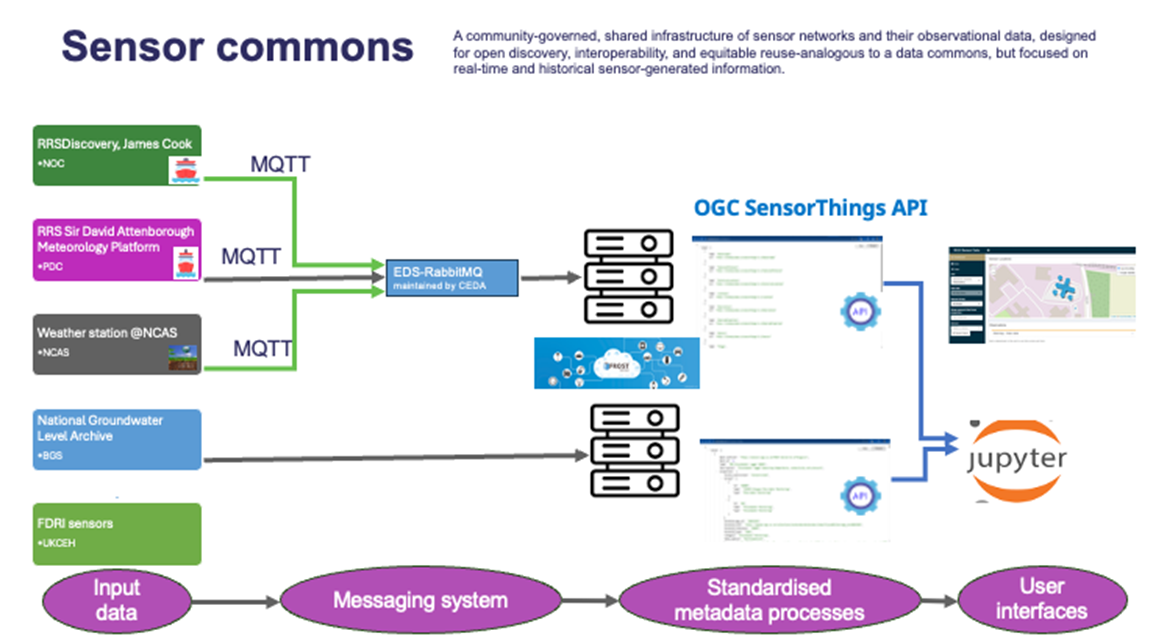
By combining technical development with user-focused design, the project was able to demonstrate how environmental data services can be improved in practice by developing and starting to build a Commons framework for sensor data. Findings from technical experiments, user research, and learnings from the project team led to over 60 actionable recommendations that can be integrated into future development of the EDS.
The recommendations covered key themes spanning governance, technical infrastructure, user needs, and stakeholder engagement. These aim to deliver a more integrated, automated, and AI-ready EDS ecosystem, reducing duplication, improving maintainability, and enabling real-time decision-making for complex environmental challenges. This foundational work will provide future benefits extending beyond science communities to policymakers, industry, and society, supporting informed responses to climate and environmental risks.
A key deliverable was the co-creation toolkit for the creation of user-friendly and effective environmental data services. This toolkit provides the resources and guidance needed to collaborate with users, gather insights, and co-design solutions that work.
A test live demonstrator service was also developed, which integrates near real-time temperature data from multiple sources, including research ships and ground-based stations, into a single platform. This highlights how data from multiple sources can be integrated to understand complex processes.
In addition, the project developed the Digital Objects Ontology (DOO) for standardisation of metadata practices. This approach enhances transparency, traceability, and interoperability, helping to ensure that research outputs align with FAIR principles and provide long-term value to the scientific community.
Two demonstration applications were also developed to remove the complexity of interacting with multiple underlying disparate sensor networks. For non-technical users, a Leaflet-based web application using map-based visualisation shows how data from developing Commons can be easily visualised but also combined with other environmental data networks, reinforcing the value of a unified access layer. For more technical users, JupyterLab-based digital notebooks provide reusable boilerplates for exploring and analysing Commons data locally. This demonstrates how common vocabularies, semantics, and standardised interfaces enable consistent data extraction and interactive analysis, while abstracting away the heterogeneity of the underlying sensor systems.
And finally, a conceptual test was conducted using Trusted Research Environments (TRE). TREs are used to integrate environmental and sensitive data securely, important when working with controlled-access datasets or sensitive linkages such as the interplay between environmental data and health, population, or infrastructure data. This provided an understanding of how a hypothetical model incorporating both geospatial and sensor-driven modelling data sources could be implemented within a specimen TRE, demonstrating how this could be developed from both architectural and modelling standpoints.
While early benefits have focused on infrastructure and data specialism, the long-term impact of AMPLIFY is much wider. Its standardised, scalable approach will support researchers, AI systems, data providers, and decision-makers, while ultimately benefitting society through better-informed responses to environmental change.