
Project summary
Funding - £500k via the NERC EDS DRI 2025 funding opportunity
Timeline - October 2025 to March 2026
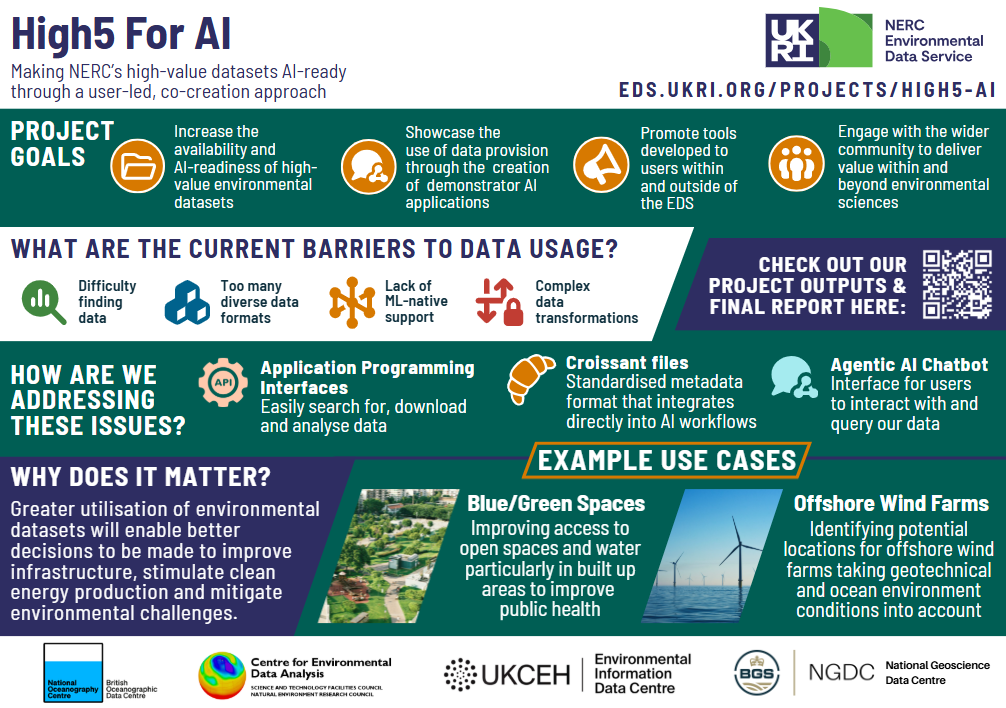
Aim - to increase the availability of high-value AI-ready EDS datasets through the development of APIs and AI tools for the environmental science community and beyond.
Core project team - Patrick Bell (project lead), Thomas Gardner, Michael Hollaway, Ag Stephens, Carl Watson
Previous research - The project builds on the outcomes of the AMPLIFY project and the work of the previous API4AI project. This project also runs alongside the FRAME-FM project.
Main goals of project
- Increase the availability of high-value data in accessible, AI-ready formats through the development of APIs
- Showcase the use of such data provision through the creation of demonstrator AI applications, such as an agentic AI chatbot that would enable easy access and utilisation of complex data through innovative interfaces
- Promote these tools to users within and outside of the EDS
- Learn from and engage with the wider community so the EDS can deliver value beyond the environmental science community by a broad range of disciplines and sectors to address key government mission challenges
Our approach
- Co-Creation and User-Led Development: Engage end users early to ensure outputs meet real-world requirements
- Rapid End-User Engagement: Leverage networks and public profiles to identify and engage users in the first two months
- Strategic Data Decisions: Prioritise dataset release to meet timelines and developer capacity
Why are we doing this?
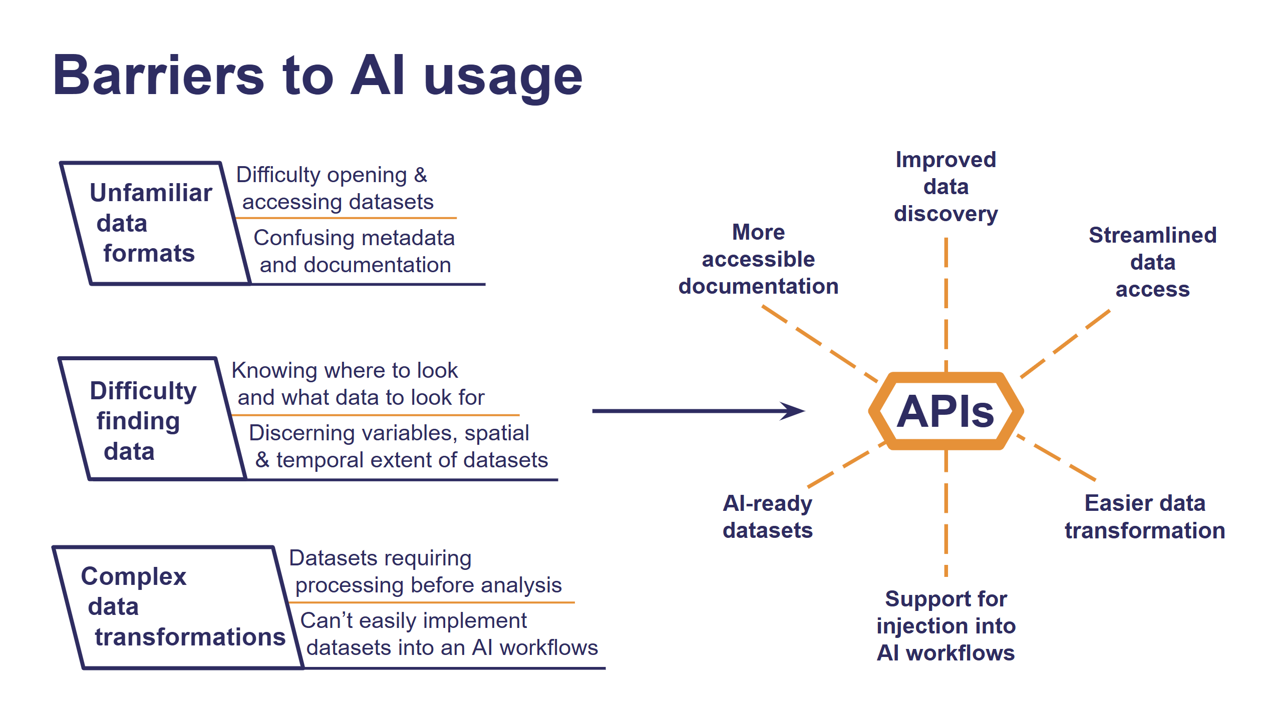
Anyone looking to use our data, with or without AI, faces several barriers that might hinder or even prevent them from achieving their goals and utilising our data to its fullest potential:
- Difficulty finding data - If you don’t know where to look, finding the right data can be tricky. Even when you’re looking in the right place, factors like variables, platforms, spatial and temporal extent can be hard to interpret when browsing our data catalogues.
- Unfamiliar data formats - Most non-scientists, and even some environmental researchers, struggle with unfamiliar data formats. This can make opening and accessing files feel like a monumental task.
- Complex data transformation - Preparing data for analysis is a necessary but complicated step, and it becomes even more challenging when integrating data into AI workflows.
What are we doing to fix it?
To tackle these issues, our goal is to develop Application Programming Interfaces (APIs) that will improve these features:
- Data discoverability - Simplify the task of finding relevant datasets required to provide solutions to societal challenges.
- Easy access - Reducing complexity when opening and reading datasets.
- AI-ready - Converting datasets into usable structures that support easy application into AI workflows and utilisation in data science more widely.
- Demonstrate the art of the possible - show how innovative agentic AI capabilities can enable easy utilisation of environmental data for a wide range of use cases beyond the traditional environmental science domain.
Why it matters
For society
Greater utilisation of environmental datasets will enable better decisions to be made to improve infrastructure, stimulate clean energy production and mitigate environmental challenges. We will particularly focus on use cases relating to clean energy and access to blue-green infrastructure for the benefit of public health.
For users of the data (e.g. researchers, developers)
- Enhances ability to implement environmental datasets into AI and machine learning workflows
- Improves accessibility, user experience and supports their needs
- More opportunities to engage with the EDS and interactively discover the powerful capabilities of AI and machine learning algorithms
For the EDS
- Enhances the popularity and usability of our high-value datasets
- Increases the understanding of our user communities and their research domains, including their processes, data requirements, and barriers to using AI in their workflows
- Improves the reach and applications of high-value EDS datasets beyond environmental science
- Enhances capability to support the science community through the provision of user-friendly tools